Dogs Running-at-Large (RAL) Laws
A Guide for Counties & Municipalities
By Kristin YarbroughUpdated Oct. 1, 2026
When family and friends visited Willard Norton, the 83-year-old immediately ushered them inside his Town Creek home. Norton’s family had contacted authorities several times regarding his neighbor’s aggressive dogs, according to the Lawrence Co. Sheriff’s Office. But since the Commission had not adopted Alabama’s running-at-large statute, deputies’ hands were tied. Steps could be taken only after the dogs attacked.
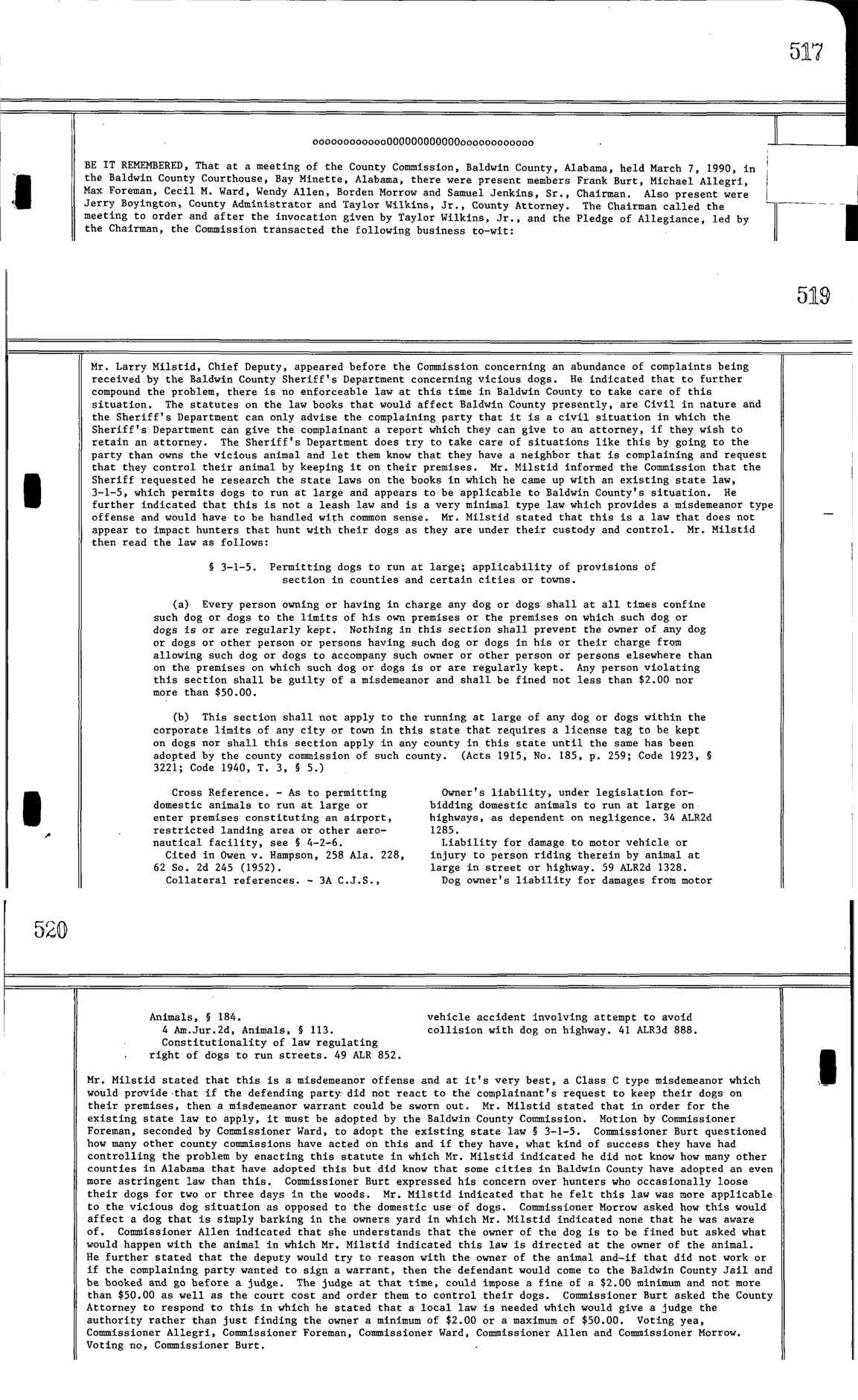
And attack they did. Willard Norton was fatally mauled in his front yard as he tended to his prized roses on June 2, 2024. At the urging of Norton’s family, Commissioners unanimously adopted Alabama Code § 3-1-5 the next month.
Since 1915, each Alabama county has had the option to prohibit running-at-large (RAL). Less than 30% have done so.
Counties and municipalities without a confinement requirement unknowingly impede their ability to protect quality of life — or, as in Norton’s case, life itself.

About Dog Confinement Laws
| Statewide Mandate | Counties May Adopt | Cities May Enact | |
|---|---|---|---|
| law | § 3-7A-1 et seq. | § 3-1-5 | Ordinances |
| summary | Dog must wear a current rabies tag, per § 3-7A-1 et seq. Dogs found at large without a tag are to be impounded. | Owners must keep dogs confined to their own premises or in the charge of a responsible person if off-premises. | In addition to prohibiting RAL, may address procedure, standards of care, etc. |
| applicability | Statewide. Tagged dogs may RAL unless prohibited by § 3-1-5 or a municipal ordinance. | Upon adoption by the Commission [see § 3-1-5 (b)], applicable in the unincorporated county and within most cities. | Upon enactment by the Council of the city or town. |
| enforcement | County Rabies Officer (tag compliance) and ACOs or LEOs (pickup of loose dogs). | The affected resident must report and, if violations continue, press charges. | Enforced by ACOs, LEOs, or Code Enforcement Officers. |
| penalty | Up to twice the state vaccination charge, a fee for vaccination, and a boarding fee. | Misdemeanor. Fine of $2–50 plus court costs. Applicable vaccination or boarding fees. | Varying fines (up to $500), plus court costs. |
| note | Although Alabama mandates impoundment, many areas do not comply. | Enforcement is possible even without ACO or LEO involvement. | See your county page for links to ordinances we’re aware of. |
See RAL Law Overview for more information.
Confinement Laws Empower Officers
Without a requirement, officers and residents can only request neighborly consideration — which tends to be ineffective for the most troubling or potentially dangerous situations. Residents may repeatedly report the same dog owner, leaving both complainant and officer frustrated at the lack of a remedy.
As Morgan County Animal Control Director Darren Tucker explained to WAAY after Norton’s death:
“I think it’s very important that each county in the state have a leash law. I believe that gives you more leverage as an animal control officer.”
Officers and residents are then empowered to address ongoing issues. In the long run, this results in fewer calls and earlier intervention, thus saving time and resources. Mobile County described their adoption of the statute as “increasing the productivity of Animal Control officers.”
Why a Confinement Requirement is Necessary
- To protect public safety. Risks must be mitigated proactively, rather than only in the aftermath of an attack. Just as Emily’s Law (Control of Dangerous Dogs, Alabama Code § 3-6A-1 et seq.). applies statewide, it follows that confinement would be required statewide as well.
- To limit government liability. Adoption of the statute and implementation of an enforcement policy demonstrate that the county or municipal government is making every possible effort to protect residents from loose dogs.
- To reduce costs and burdens. Fewer at-large dogs means fewer litters, less abandonment and surrender, reduced numbers of dogs killed due to shelter overcrowding, and fewer car accidents involving dogs. Confinement law is an important factor in reducing shelter intake.
- To protect animals. Loose dogs may be hit by cars (in which case they also endanger drivers), can fight with other animals, can harm livestock or other pets, and may result in the dog being shot.
- To progress cultural norms. The existence of the confinement requirement can slowly affect the culture of dog ownership in the county or municipality. Just as Alabama gradually shifted from open range for livestock to closed range between 1866 and 1941, adoption of the law can nudge residents toward keeping dogs on their own property.
- To prosecute cruelty and other criminal activity. Because enforcement involves interaction with dog owners, confinement requirements can lead to discovery of other concerns or criminal activity.
Why Haven’t Counties Adopted § 3-1-5?
- They haven’t realized that § 3-1-5 must be adopted. Nearly every Alabama state law is automatically statewide law. It is unusual and illogical that a state law is applicable in only a fraction of the state. Some residents and officials remain dubious even when directed to the adoption requirement plainly stated in the second paragraph of this two-paragraph statute.
- They haven’t heard of § 3-1-5. While researching § 3-1-5 status, we learned that many officials, even some who work in law enforcement or animal services, have not heard of the statute. Many officials commented that their county needed a requirement due to a large number of loose dogs. They did not know a statute had been prepared over a century ago and awaited their adoption.
- They believe they cannot adopt because the county has insufficient animal services. Actually, § 3-1-5 can be enforced without animal services, and allowing roaming only increases the need for animal services due to increased breeding, public safety issues, and conflicts between neighbors. A dog confinement requirement reduces shelter intake.
How Governments Can Implement a Confinement Law
- A basic enforcement procedure must be established. Magistrates, ACO(s), LEOs, and/or Code Enforcement Officers must familiarize themselves with the law and their role in its enforcement. For example, see How to Report Dogs at Large.
- Basic supports for dog owners, such as trolley lines provided by an ACO, can help residents keep their dogs at home. Arab Police Department’s Paw it Forward Fund is a model program.
- A confinement law may be adopted by the County Commission via Resolution or enacted by the Council. The City of Arab's animal ordinance provides an excellent example of a confinement requirement as well as an impoundment procedure and basic standards of care for dogs kept outside.
- Communication about the requirement and enforcement procedure through government websites, social media, and traditional media. For example, see Mobile County’s press release and this article about Blount County’s procedure. Every county and municipality should include information about animal laws, reporting, and enforcement — including related to § 3-1-5 status and municipal ordinances — as well as Animal Control and impoundment, even if these mandated services are not provided.
Myths & FAQs
Will more ACOs be necessary to enforce this law? No. There may be a increase in calls as residents first become aware of the statute’s adoption. Over time, calls can be expected to decrease because offending owners can be penalized rather than only asked to be considerate. Additionally, much of the frustration in the absence of the statute is due to the lack of recourse. When a recourse is placed in the hands of residents, most residents face that it is up to them to take action rather than continuing to report or blaming officers.
We have no animal control. Doesn’t that need to be figured out first? Although Animal Control should be implemented, enforcement is possible without ACOs. Any officer can respond to calls, and can do so when in the area since RAL calls are not urgent. Shelby County offers another possibility: instead of dispatching an officer when a complaint is received, the county mails a letter to the suspected dog owner.
Will this law tread on the freedom of dog owners? A frequent misconception is that officers will check every property across the county’s 100s of square miles to ensure compliance. This is never the case. Since enforcement is only according to reports, the vast majority of dog owners are unaffected. The law merely allows officers to act: it does not create a duty to act. As was said by the Blount County Commission Chairman upon adoption of the statute,
“The County Commission is not in the business of implementing rules and restrictions. What we’re trying to do is put a tool in the toolbox.”
Why are residents asked to document violations prior to reporting? This is a suggested step because a) it guides residents to report only repeat issues related to neighbors who are not confining their dogs, and b) documentation is usually required for pressing charges. (The one exception we are aware of is that when a resident presses charges in Lee County, Lee County Animal Control is subpoenaed to provide evidence to the court of previous efforts to address the situation, such as a record of multiple calls regarding the neighbor’s at-large dog.)
How does confinement law impact the judicial system? Responsible enforcement results in minimal impact on the judicial system, for several reasons:
- Most owners comply when educated about the law or when offered assistance in keeping a dog on-premises.
- Few officer citations can be issued since officers must witness the violation.
- Rarely are charges filed via Complaint due to the requirements
The primary utility of dog confinement requirements is to address negligent dog owners, not to penalize the considerate neighbors when a dog accidentally is let out or escapes a fence.
Due to the conditions required for officer citation, few are issued; due to the requirements for bringing evidence to the magistrate, rarely are charges filed.